When Rent Is Not Enough:
Commercial Leases and Investment Protection for Small Businesses in Nigeria
𝑬.𝑽 𝑨𝒕𝒆𝒏𝒂𝒈𝒂 & 𝑨𝒔𝒔𝒐𝒄𝒊𝒂𝒕𝒆𝒔 𝑳𝑳𝑷
7/1/2026
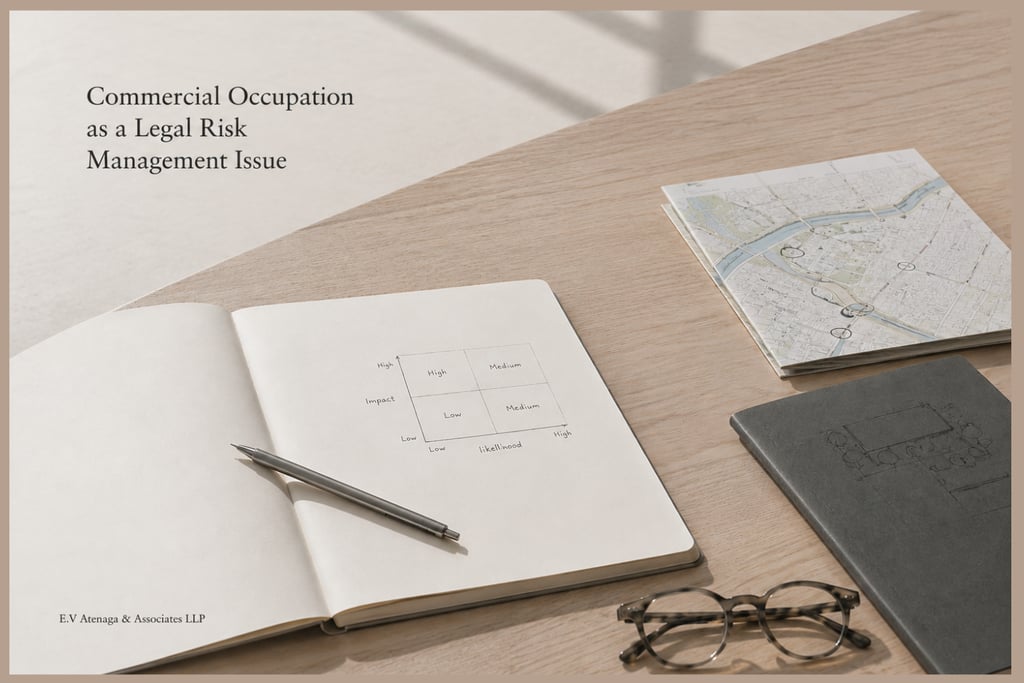
Commercial Occupation as a Legal Risk Management Issue
Businesses often approach commercial premises primarily from an operational perspective. Location, accessibility, visibility, and cost typically dominate negotiations. Legal considerations are sometimes addressed only after commercial terms have been agreed.
However, where substantial investments are contemplated, the legal structure governing occupation should form part of the broader risk management strategy of the enterprise.
The question is not simply whether the premises are suitable for business operations today. It is whether the legal framework governing occupation is sufficiently robust to protect the investments, goodwill, and commercial interests that may develop over time.
In many cases, the answer depends less on the amount of rent being paid than on the quality of the legal arrangements supporting occupation.
Conclusion
The distinction between an ordinary tenancy arrangement and a properly structured lease assumes particular importance where substantial capital expenditure is contemplated.
For businesses that invest heavily in commercial premises, legal protection extends beyond the right to occupy a property. It encompasses the mechanisms through which renovation investments, business continuity, commercial goodwill, and future expectations are protected over time.
A well-drafted lease provides a framework through which these interests can be addressed with greater certainty. By regulating alterations, renewal rights, improvement-related obligations, and termination procedures, it enables parties to allocate risks more effectively and reduce the potential for future disputes.
In the context of commercial occupation, the legal structure governing possession is therefore not merely an administrative formality. It is a significant component of investment protection and long-term commercial planning.
References
Legislation
Land Use Act 1978.
Cases
Osho v. Foreign Finance Corporation (1991) 4 NWLR (Pt. 184) 157.
Other Authorities
Applicable State Tenancy Laws.
Recovery of Premises Laws applicable within the States of the Federation.
Common-law principles governing leases, fixtures, and proprietary interests in land.
Doctrinal materials on commercial leasing, business tenancy protection, fixtures, and contractual allocation of renovation risk under Nigerian property law.
© 2026 𝑬.𝑽 𝑨𝒕𝒆𝒏𝒂𝒈𝒂 & 𝑨𝒔𝒔𝒐𝒄𝒊𝒂𝒕𝒆𝒔 𝑳𝑳𝑷. 𝑨𝒍𝒍 𝒓𝒊𝒈𝒉𝒕𝒔 𝒓𝒆𝒔𝒆𝒓𝒗𝒆𝒅.
For businesses that invest heavily in commercial premises, the principal legal risk is often not the cost of renovation but the extent to which those investments are protected by the legal structure governing occupation of the property.
Introduction
Commercial premises frequently represent one of the most significant investments made by small and medium-sized enterprises. Beyond the payment of rent, businesses often commit substantial resources to adapting premises to their operational requirements through renovations, fit-outs, structural modifications, branding installations, and specialised infrastructure.
In many sectors, these investments are not merely aesthetic improvements. They form part of the business's operational foundation. Restaurants install commercial kitchens and ventilation systems. Pharmacies redesign storage and dispensing areas to meet regulatory requirements. Retail outlets invest in branding and customer-facing layouts. Professional service firms undertake extensive interior modifications to accommodate staff and clients.
Yet, despite the scale of these investments, many businesses continue to occupy commercial premises under arrangements that provide limited protection for the commercial value they create.
This raises an important legal and commercial question: to what extent does the legal basis of occupation protect a business that has invested substantially in premises it does not own?
The answer often lies in the distinction between an ordinary tenancy arrangement and a properly structured lease.
The Commercial Significance of Leasehold Security
The legal structure through which a business occupies property can have profound implications for commercial stability and long-term planning.
Many commercial occupiers operate under periodic tenancy arrangements, often assuming that the regular payment of rent provides sufficient security of tenure. While Nigerian law affords tenants protection against unlawful eviction and regulates the process through which possession may be recovered, a periodic tenancy remains fundamentally different from a leasehold interest.
A lease creates a recognised interest in land for a defined term and on agreed conditions. It provides a greater degree of certainty regarding occupation and enables the parties to regulate important aspects of their relationship in advance.
The legal framework governing leases in Nigeria is derived from the Land Use Act 1978, applicable property and conveyancing legislation, common-law principles, and judicial authorities concerning possessory interests in land.
In Osho v. Foreign Finance Corporation (1991) 4 NWLR (Pt. 184) 157, the Supreme Court reaffirmed the legal character of leasehold interests and recognised the enforceable rights arising from such arrangements.
From a commercial perspective, the significance of a lease lies not simply in the right to occupy premises but in the degree of certainty it provides. Businesses contemplating substantial expenditure on another person's property require a legal framework capable of supporting long-term investment decisions. The predictability associated with a lease often provides a stronger basis for such decisions than a periodic tenancy arrangement.

When Commercial Value Becomes Location-Dependent
As businesses mature, their commercial success frequently becomes linked to a particular location.
Customer familiarity, market visibility, accessibility, and operational efficiency may all become associated with the premises from which a business operates. In some cases, the location itself becomes part of the enterprise's commercial identity.
This phenomenon is particularly evident in sectors that depend on customer footfall, local recognition, and geographic accessibility. Retail businesses, hospitality operators, healthcare providers, beauty and wellness establishments, and professional service firms often derive substantial value from continuity of location.
Where occupation is uncertain, the consequences extend beyond the loss of physical premises. Relocation may affect customer retention, disrupt established trading patterns, increase operational costs, and diminish the commercial benefits associated with a particular location.
The legal basis of occupation, therefore, assumes increasing importance as commercial goodwill becomes attached to the premises.
Renovation Investments and
The Law of Fixtures
One of the most complex issues arising in commercial occupation concerns the legal status of improvements made by tenants.
Businesses frequently undertake extensive renovations without fully considering the legal implications of those improvements upon the termination of occupation. The assumption that ownership automatically follows expenditure is not always consistent with established principles of property law.
Under common-law principles applicable in Nigeria, the legal treatment of an item may depend upon the nature, purpose, and degree of its attachment to the property. Certain installations may retain their character as removable assets, while others may become fixtures that form part of the land itself.
The distinction is often significant.
A business may invest in specialised plumbing systems, permanent partitions, electrical installations, flooring, storage facilities, ventilation infrastructure, or integrated operational equipment. Depending on the circumstances, disputes may arise concerning whether such improvements remain the property of the tenant or become part of the landlord's premises.
The legal consequences can be substantial. A tenant who has invested heavily in improving commercial premises may find that some or all of those improvements cannot be removed at the end of the occupation period.
Accordingly, businesses contemplating significant capital expenditure on leased premises should consider not only the cost of the improvements themselves but also the legal framework governing their ownership and treatment upon termination.
Why Commercial Leases Offer Greater Investment Protection
A properly negotiated lease serves a broader function than merely granting possession of premises. It establishes a legal and commercial framework through which the parties can allocate risks, define expectations, and regulate future contingencies.
This becomes particularly important where the tenant intends to undertake substantial renovations or long-term commercial development.
The commercial value of a lease lies largely in its ability to align investment horizons with legally protected rights of occupation. Where a business expects to recover capital expenditure over several years, certainty regarding the duration and conditions of occupation becomes commercially significant.
Equally important, a lease provides an opportunity to address potential areas of disagreement before they arise. Matters relating to improvements, alterations, renewal rights, maintenance obligations, insurance responsibilities, and termination procedures can be addressed expressly through contractual drafting.
In this respect, the lease functions not merely as a document governing occupation but as a mechanism for managing commercial risk

Contractual Mechanisms for Protecting Renovation Investments
The effectiveness of a commercial lease often depends on the quality of its drafting. Certain provisions assume particular importance where a tenant intends to invest significantly in the premises.
Alterations and Improvements Clause
The Alterations and Improvements Clause regulates the tenant's authority to modify the premises and establishes the legal consequences of those modifications.
A carefully drafted provision should specify the scope of permissible works, identify circumstances in which landlord consent is required, allocate responsibility for construction costs, and determine the status of improvements upon expiration or termination of the lease.
Particular attention should be given to whether installed improvements may be removed by the tenant and the condition in which the premises must be returned. The absence of clear drafting in this area frequently gives rise to disputes concerning ownership and restoration obligations.
Term and Renewal Clause
The Term and Renewal Clause is central to the commercial viability of many renovation projects.
Businesses rarely realise the full value of capital investments immediately after occupation. Customer acquisition, market penetration, brand development, and operational optimisation generally occur over time. Consequently, the duration of the lease should be sufficient to permit the tenant to derive commercial value from investments made in the premises.
Renewal provisions are equally important. Where significant goodwill has become associated with a location, the ability to extend occupation may be critical to preserving business continuity and protecting long-term investment.
Compensation for Improvements Clause
The Compensation for Improvements Clause addresses circumstances in which improvements made by the tenant remain with the property after the lease comes to an end.
Where renovations materially enhance the utility, functionality, or value of the premises, the parties may agree upon a framework for assessing and compensating retained improvements. Such provisions can assist in balancing the interests of both landlord and tenant and reducing the likelihood of disputes at the conclusion of the lease relationship.
The commercial significance of this clause often increases in proportion to the scale of the tenant's investment.
Termination and Default Clause
The Termination and Default Clause provides the procedural framework governing the end of the lease relationship.
A comprehensive provision should clearly identify events constituting default, establish applicable notice requirements, define opportunities to remedy breaches where appropriate, and specify the legal consequences of termination.
Well-drafted termination provisions contribute significantly to commercial certainty. By clarifying the rights and obligations of the parties in advance, they reduce the likelihood of disputes and facilitate more predictable outcomes where disagreements arise.

Visit Our Office
Office Address
E.V Atenaga & Associates LLP, Benin Sapele Rd, Ikpoba Okha, Benin City 300105, Edo, Nigeria.
Contact Us
+234 -708 - 562 - 8297
info@evallp.com
© 2026 E.V Atenaga & Associates LLP. All Rights Reserved.
MODERN LEGAL SOLUTIONS FOR A BORDERLESS WORLD